


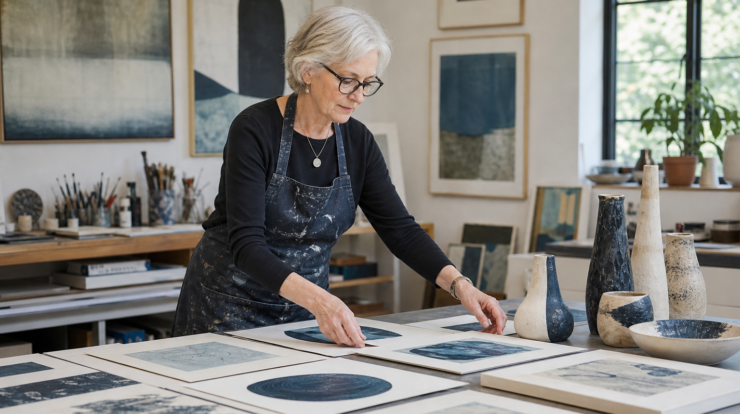
Experimenting with different mediums can invigorate your creativity and expand your audience. But when it’s time to present a portfolio—whether for a gallery, exhibition, or your own website—consistency becomes crucial. No matter how many mediums you choose to showcase, what counts is cultivating a clear through line that ties your work together.
Galleries look for portfolios that feel intentional and professionally curated. Even a diverse body of work can read as focused and connected if it’s assembled thoughtfully. Use this framework to assess and refine your portfolio for consistency:
Portfolio Consistency: The Six Pillars
Evaluate how your work aligns on each of the following axes. Strong cohesion in at least three (ideally four) is usually enough to make a multi-medium portfolio feel unified:
- Subject Matter – Are recurring motifs, themes, or imagery present throughout your works?
- Theme or Concept – Is there a driving idea, question, or story that weaves through the collection?
- Style – Do your works share a similar mark-making, form language, composition, or level of realism/abstraction?
- Palette – Is there a recognizable color strategy—such as earth tones, bold primaries, or limited monochrome—visible across multiple pieces?
- Medium – Do you stick to one medium, or do you move confidently between two or more? If so, is there a through line despite the material change?
-
Presentation – Are framing, mounting, or other finishing details consistent and professionally executed?
Practical Rule: You don’t need uniformity in every area, but at least three clear connections give your portfolio cohesion. Galleries can quickly sense when work, regardless of medium, is part of a coherent vision.
Examples of Consistency in Action
- If your sculptures, prints, and paintings all explore botanical forms—using bold linework and muted colors—your audience sees a unified vision.
-
Presenting animal-themed ceramics and paintings, both rendered in loose, expressive style, anchors your work even as materials change.
Common Pitfall: Tossing together unrelated stand-alone pieces in varying styles, subjects, and presentations fractures the sense of intent. This often reads as disjointed and dilutes your professional presence.
Organize with Purpose
Aim to tell a visual story. Sequencing and grouping can highlight shared threads: place works with the same subject or palette together. Consider pairing across media—for example, display a painting and a ceramic piece depicting similar themes side by side. The way you structure your portfolio can underline the connections you want viewers (and gallerists) to see.
Tip: Avoid the temptation to include every favorite. Leave out strong works that don’t support the core visual or conceptual threads.
Multi-Medium Portfolio Checklist
- [ ] Recurring Subject or Theme: Is there clear overlap in imagery, topics, or ideas?
- [ ] Visual Style Unity: Do works share line, brushwork, composition, or abstraction level?
- [ ] Palette Consistency: Are color decisions deliberate and harmonious?
- [ ] Consistent Presentation: Are all works well-photographed, framed, or displayed at the same professional standard?
- [ ] Intentional Grouping: Are works sequenced to emphasize their connections?
- [ ] No Outliers: Have you removed works that disrupt the visual or conceptual unity?
Takeaway: Embracing more than one medium can be a strength, but professional artists know their portfolio needs careful editing and thoughtful organization. Focus on visual and conceptual continuity, not mere variety. Before sharing your next portfolio—online or with a gallery—review it against the six pillars and checklist above. Small adjustments can turn a scattered collection into a compelling, memorable statement.
Reader Question: How do you ensure cohesion in your own multi-medium portfolio? What challenges have you faced, and what strategies have helped make your presentation stronger?

Always such good information. Thank you, Jason!
I have come to rely on my themes and concepts as an anchor along with a medium that has a bit of breadth but a distinct appearance. Everything else I feel lexible about. the theme / concept may not appear at the outset b ut does seem to reveal itslef for good or ill as I work.
That said, I’m not sure my work can adequately reach a market. It is primarily “digital” in execution and the current AI “bruhaha” which I beliueve is warranted has poisoned many wells where non-AI digital work is being done.
I offer this not as arugment but as a limited obersvation.
Still banking on collectors falling ion love with an image regardless, but I’ haven’t found where they are as yet.
I am currently creating studies on paper, in either pastel or acrylic. These I eventually paint enlarged on canvas to about four times the area.
My studies have found an outlet in a gallery that allows unframed work to be displayed. Some of my canvases are still trying their luck with distant galleries. The rest I hold onto, while I mull over what I want to do with them.
Good advice as always. Here is a good question — if we as artists can recognize AI-generated art the second we see it, and even recognize when human artwork has been produced from AI-generated refs, is it just as reasonable to assume that good readers recognize AI-written blog posts the second we read them? And do those AI-written blog posts (and artist statements, art descriptions, art brochures, etc) feel every bit as generic to good readers as AI-produced art? Yes, the answer continues to be yes with writer after writer after writer. I have bought multiple books in the last few months “written” by artists I respected and trusted, only to realize within the first chapter that the book was actually written by AI, so that it sounds like every other AI-written material I’ve read, making the anticipated book boring and predictable, and now I wonder in what other areas those artists are cutting corners. I no longer follow those artists because I no longer have a way to know when something that has their name on it is actually from them. The information in their book was “good” but basically just like what everyone else is pumping out through AI, and the writing from different author names — names in the art world that you might recognize — all read like it was popped out of the same template, because it was. AI-produced writing might have been a good choice for bloggers and artists when the technology first came out, just like AI-produced art and refs were, but it is now just as recognizable for good readers as AI-produced art and AI-produced refs are for trained artists. It’s an understandable corner to cut, just like AI-produced art and info-posters and so forth are an understandable corner to cut, but it is still generic, predictable, and problematic. There are some people who know how to use AI-generated material in unique ways. Kelly Boesch is a name that comes to mind. But most people are using AI as a quick fix with no understanding of how homogenized and “mass-produced” it is making them.