


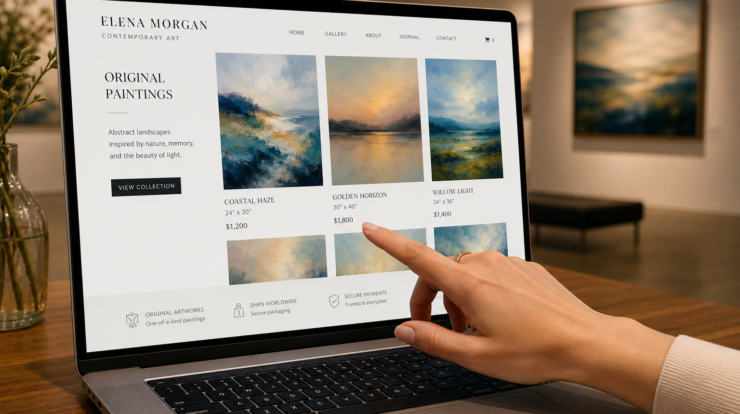
Among the recurring debates in the art world is whether or not artists should display prices on their websites. Walk the halls of any art fair or gallery, and you’ll find opinions split down the middle—often with deep conviction on both sides. Traditionally, pricing has been kept under wraps, but online culture—and the expectations it has fostered among buyers—challenges that secrecy.
As a gallery owner who hears this question weekly, let’s challenge the conventional wisdom and look at what’s genuinely at stake.
The Case for Openness: What Artists Gain
It’s easy to see why sharing prices feels risky. You worry about alienating potential collectors who perceive your prices as too high. Or perhaps you fear looking amateurish or undercutting your gallery partners. But in my experience, hiding your prices is often a greater barrier to sales—and here’s why.
Today’s art buyers, especially those discovering art online, expect transparency. If a collector lands on your website and can’t immediately see a price, many won’t pick up the phone or fill out a contact form—they’ll simply move on, uncomfortable with the mystery (not to mention the implied need for negotiation). The lack of pricing can come across as evasive or even elitist.
Meanwhile, when an artist clearly lists prices, three things happen:
- You qualify your audience. People who engage are serious.
- You build trust. Transparency signals professionalism and respect for a collector’s time.
- You gain control of your brand narrative. You can anchor expectations rather than let assumptions (often wrong) control the conversation.
The Argument Against: What Needs Protecting
Of course, there are legitimate reasons to hesitate. Some artists worry about conflicting with galleries or undermining those relationships. Your gallery might handle pricing differently, or have regional pricing structures due to market differences. There’s also the concern of being too rigid—will public pricing tie your hands in negotiation?
Perhaps most importantly, you might sell through multiple channels, with galleries taking their commission while direct buyers don’t. Aligning these prices transparently takes careful thought.
Solutions That Bridge the Gap
Instead of clinging to one dogma or the other, here are practical adjustments any professional artist can adopt:
- Coordinate with your galleries. Proactively communicate your policy and ensure your website prices match (or are higher than) those in galleries. Gallery relationships thrive on trust and alignment, not secrecy.
- Use price ranges, not single numbers. If you work in many sizes or want some flexibility, list a range (e.g., "$950–$3,200") or "work this size is typically $1,800 – $2,200". This maintains clarity while allowing for adjustments.
- Provide a downloadable price list. Offer a PDF catalog or inventory sheet—collectors who download are invested, and you gain a contact for follow-up.
- Be clear on the process. If prices are complex due to framing, shipping, or editioning, spell out how buyers can expect to get a full quote. Never leave them guessing.
- Update regularly. Outdated pricing hurts credibility more than listing prices ever could.
A Gallery Owner’s Perspective
As someone who negotiates sales daily, I’ve observed that collectors almost never walk away from serious interest after seeing a price. If anything, the most awkward interactions are with those who don’t know what to expect; their uncertainty leads to indecision or embarrassment. Straightforward artists build momentum by being upfront.
When artists hide their prices, the responsibility falls back on galleries to answer basic questions—slowing down the sales process and sometimes creating confusion. Unified, public pricing empowers everyone in the chain.
The Real Risk: Losing Qualified Buyers—Not Revealing Too Much
If your art is priced fairly and consistently, with reasonable justification behind it, there is no reason to keep it secret. Open pricing is a hallmark of professionalism and gives you an edge (especially online). Hiding prices, on the other hand, projects the opposite: that you haven’t done the research, aren’t ready to stand behind your work, or (worst of all) that buying is only for insiders.
Takeaway
Transparency, when coordinated and strategic, removes obstacles. Publish prices—or at least clear guidance—and update consistently. The rewards: fewer uncomfortable conversations, more qualified leads, a faster sales cycle, and stronger professional reputation.
Sound Off: How do you handle pricing on your website? What’s kept you from making your prices public—or what have you learned from doing so? Share your experience below.

TH 20 AUG 2026
While I am not an experienced “selling” artist/photographer, I have had some successes selling my work at personally staged shows in California when I lived there.
I made prices prominent & was willing to negotiate to make the sale. My experience was positive with that practice, and the folks that purchased appeared happy at the end of the process. A few made additional purchases over the following three years. That was about 17 years ago. I am gearing up to take another stab at it and feel that I will pursue a similar strategy. But perhaps a bit less willing to negotiate.
The intervening years have strengthened my belief in the quality of my work, and therefore I do not believe it’ll be an issue. In fact, I think it will increase the perceived value of it.
I’m hard pressed to think of ANY purchase I’d consider without knowing the price first; a bag, coat, computer, a piece of jewelry or a work of art. I wouldn’t wander around Nordstrom looking for an associate to tell me, and I certainly would expect those items to be clearly priced when I’m looking their website. I’m put off even when Best Buy says, ‘add to cart to see special pricing.’ Nope. If I’m absolutely in LOVE with something I’ll almost always consider going over my intended price point. But if the price is four times more than I have budgeted, I’ll have to find something else. I can’t imagine not having clearly posted prices on my website.
This is mainly my experience from doing shows; I don’t think showing your prices hurts. If people can afford them, they’ll know up-front and maybe purchase. The people who love the work but can’t afford it yet might keep it mind for a time when they can. I think having to ask is a barrier to a lot of (especially mid-range) buyers. I know it would be to me in that situation.
I feel transparency is the best policy. My collectors know what to expect before making a decision about purchasing a painting. We avoid awkward conversations that way.
My prices are listed clearly with frame included. However if the client has a reason to negotiate, I can do this individually. Usually that occurs if the client does not like or want the frame. I will change the frame with something of their choice (usually it is something simpler and less expensive, or someone who does not want a frame). Recently I wanted offer to change a frame that had a small defect but the client wanted to buy it at the posted price even with the defect, Recently I was asked to remove the gold frame as the clients father wanted to make a frame for it. He sent me a picture of the proposed frame (as I was waiting for the painting to dry before sending). I responded that I did not think the frame complemented the painting. I sent jpegs where I painted his frame around one copy, and my typical gold frame around another copy. He agreed my frame choice was a better match, but still wanted it without a frame.
Experience has taught me that collectors appreciate transparency. I clearly list prices both online and in-person. Online, there is the price, and a range provided for shipping (since those prices fluctuate based on market and location), as a note for clients to plan for an additional 10-15% of the cost of the piece to cover packing & shipping.
I show & sell my work in-person with very simple frames. Online I provide a limited number of options for framing (including none), which is in addition to the cost of the piece. Once a collector selects what they want, they see the total cost right away.